Digital Asset Management

The digital media database of the KIT contains more than 250,000 image media and moving image material from the areas of documentation for public relations, science communication and research documentation. Please contact us at mediendb∂km.kit.edu.

In addition, all KIT institutions have the option of creating their own independent archive areas, which are managed by the media database team. As an interface, we combine the tasks of the media database with the activities of the teams in our department under a common interface. The media database is also the interface and preliminary stage to the KIT archive and thus the short-term memory of the KIT.

Search, collect, present, publish, research!


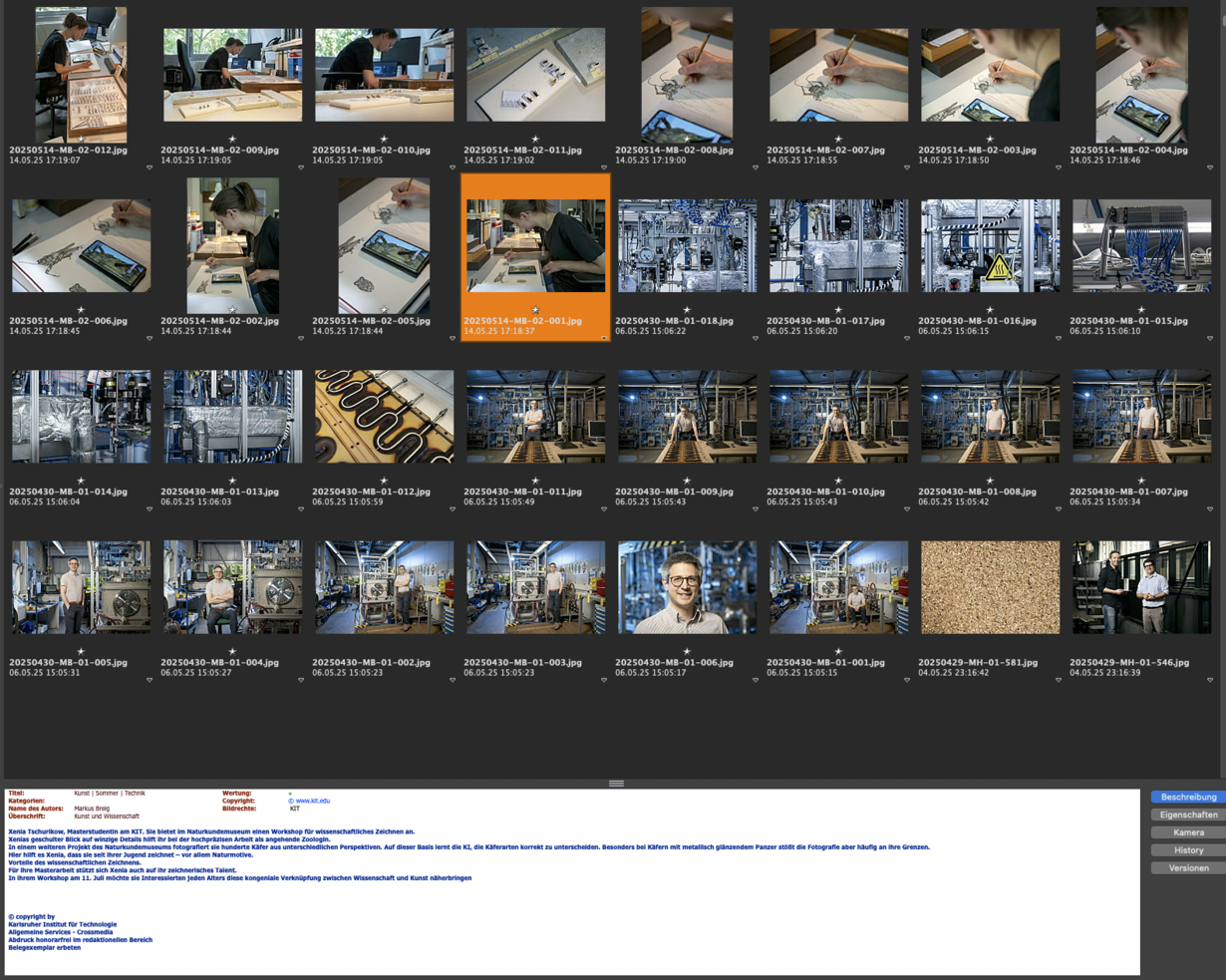
Bild einer Übersicht von Fotos mit Metadaten KIT
Provision of an image selection
Hand – eine Person schreibt mit einem silbernen Kugelschreiber auf Papier.
Registration in the media database
Foto von einem Fragezeichen KIT
Questions about use
Hochlohniges Veranstaltungsforum im Innenhof eines Industriegebäudes mit Bühne, Publikum. KIT, Amadeus Bramsiepe
Projects


Our offer

  • Support with image research
  • Explanation of the functions for users
  • Archiving and distribution of image material
  • Creation of independent archive areas

FAQ

Who can register in the media database?
All KIT members and employees of the cooperation projects who have a necessary research reason. In exceptional cases, external KIT members may also be granted access. Please send us an e-mail to bildanfrage∂kit.edu stating the reason for your search. After checking your access authorization, we will activate your registration.
Do I automatically have access to the database with my KIT account?
Your KIT account does not give you automatic access to the media database. This requires a separate registration, which requires a specific research project.
How long is my account valid?
Once your registration has been activated, you can access the database for 3 months. We can easily reactivate your account after this period has expired. We can also activate your account for a longer period.
How does ordering images from the media database work?
Once you have found photographs for your purposes, you can order them using the shopping cart tool. Please enter your reason for use in the comments field during the ordering process.
How are images provided for a specific search request?
We will create an album for your motif requests, which we will send to you via a link. The link is valid for a limited period of time, during which you can download the desired images in the appropriate format.
How can I download images that have been provided to me in an album?
If you only want to download individual photos from the image selection, you can select them by clicking on the small tick at the bottom right of the image. The action bar at the bottom of the page then pops up and you can start the download.
To download all images together, select the first image in the album with the small tick and then the last image in the album by holding down the Shift key. The download can then be started.
What does it cost to provide the photos?
The photos can be used free of charge in the editorial area of the KIT. Any commercial use is not permitted.
How do I indicate the copyright notice?
A copyright notice is required when using the images. Please indicate this as follows: (Photo: KIT/photographer)
You will find the name of the photographer on the respective image in the "Rights" section under "Source".
Question?
Do you still have questions? Please contact mediendb∂km.kit.edu

Projects


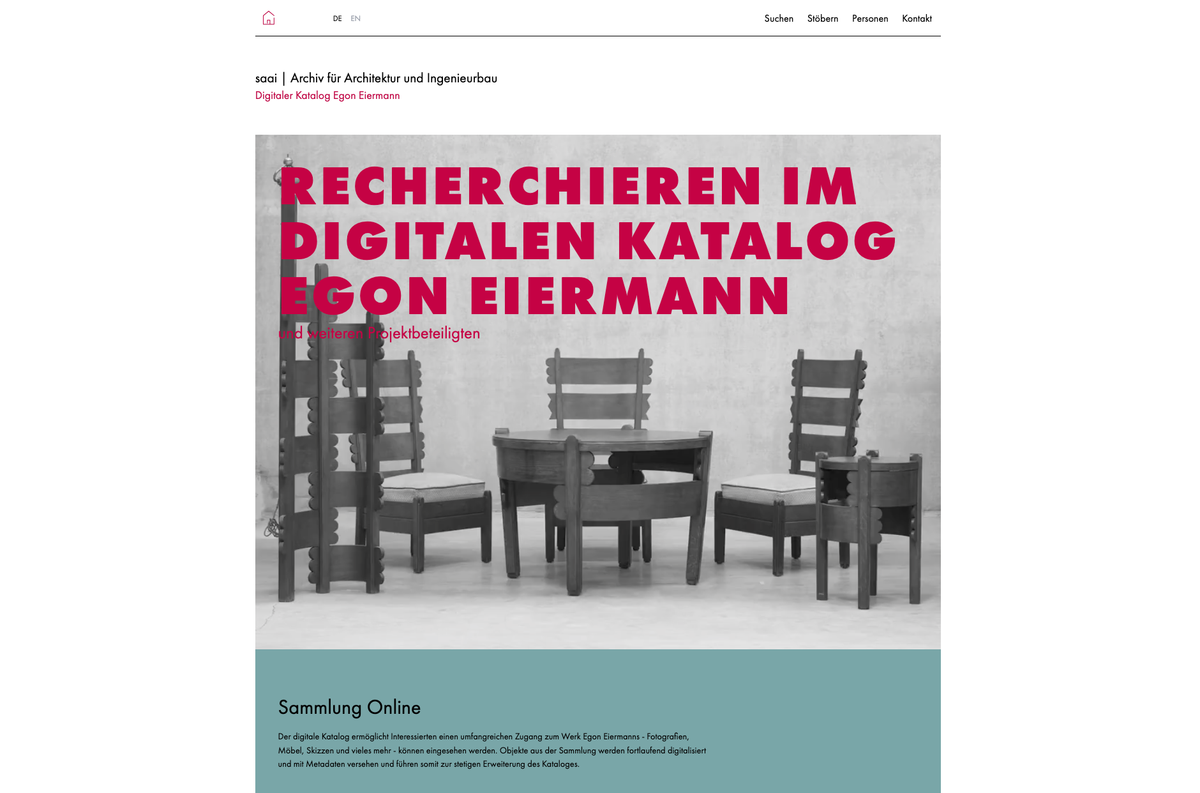
Digital catalog of Egon Eiermann's work archive

The digital catalog gives interested parties comprehensive access to Egon Eiermann's work  photographs, furniture, sketches and much more  can be viewed. Objects from the collection are continuously digitized and provided with metadata, thus leading to the constant expansion of the catalog.
This catalog is based on a separate database site. Together with colleagues at saai, the archive for architecture and civil engineering, a metadata set adapted to Bearf was developed for indexing. With the help of this metadata, the digital assets can be mapped, organized and searched in various ways.
KIT